Real music lovers can find the melody in everything. From the park to the concert hall, our friend Nelson Brill is always on the hunt for great sound.
In this article, Nelson takes a look at the effects of Nordost’s QRT products!
QUANTUM RESONANCE TECHNOLOGY (“QRT”) POWER DISTRIBUTION PRODUCTS-THE IMPORTANCE OF CABLES, AC SUPPLY AND POWER DISTRIBUTION TO AN AUDIO SYSTEM
BY NELSON BRILL SEPTEMBER 28, 2014
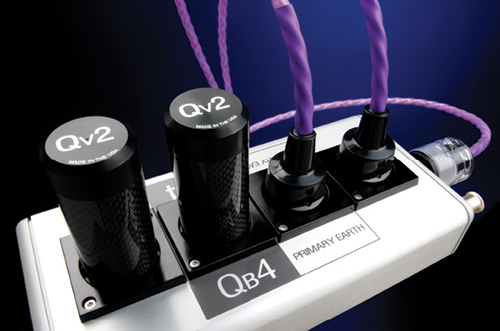
All of my reference listening systems are founded on close attention paid to audio cables, AC supply and power distribution. This includes separate dedicated electrical lines from home electrical board to the listening systems; grounding of the systems by running a ground wire from Quantum Resonance Technology (“QRT”) “Q-Base” AC Distribution power strips to a grounding rod placed in the yard; and, on the recommendation of mentor Roy Gregory, (he the founder of the insightful audio review publication, The Audio Beat- www.audiobeat.com), creating a consistent “cable loom” where all cables are of similar materials and technology. Many people believe that all audio cables sound alike, and that cheap cables and attention to AC supply and distribution to an audio system makes little sonic difference and is not worth the expense. Nothing could be further from the truth. Audio cables all have sonic signatures and are an absolute critical factor in audio system performance and enjoyment. The same is true for keeping your AC supply to your audio system as clean and noise free as possible, along with making sure that distribution of that power is attained with as clean a source as possible.
QRT products are distributed through Nordost Corporation (www.nordost.com) as is their “System Set-Up and Tuning” CD (a must have CD for aiding in system set up and maintenance). What the QRT products offer is a vital foundation, where music emerges from a quiet background with all of its textures, inner details and the ambiance of particular recording space intact as much as possible. Nordost has recently upgraded all of their cable products to V.2 versions. From what I have heard so far in listening to these new versions (in both Nordost’s own listening room and in other systems), these new V.2 versions bring even more resolution and a feeling of an unforced, natural conduit for the music to flow forth dynamically (if the system and the recording allows) – a quality of Nordost cables that has always been their (enviable!) hallmark.
Here is my older review of QRT power distribution products, distributed by Nordost, published in The Stereo Times to offer more details of my own findings:

storemetmuseum
Coming through the huge vestibule of the Great Hall at the Metropolitan Museum of Art in New York City on a recent early Spring day, one does not hear the pollution of mains power emanating from the countless wireless devices in use, from cell phones to gallery talk recorders. Instead, one hears the cacophonous din of hundreds of human voices, (in many languages), captured beneath the Great Hall’s stone rotunda. Near the huge cauldron of white blossoming flowers (placed to greet visitors with a tease of Spring) is an elderly couple; she’s combing the last strands of her husband’s balding head to make him look presentable to the Pharaohs, Medici rulers and the voluptuous women of Renoir within. In another corner is a gaggle of Japanese teenagers decked out in the latest collection of rainbow colored sneakers, oversized black eyeglasses (resembling 3-D frames), and sporting colorful gadgets (with their myriad Apps), waiting for a museum guide to whisk them away to view the world of Victorian Photocollage. Ascending the Hall’s main staircase brings one to a hushed gallery where the drawings of the Florentine artist, Agnolo Bronzino (1503-1572), are on exhibit. In Bronzino’s time, the art of Disegno, the drawn line, was considered a functional activity, done to perfect designs for final works in painting or sculpture. As New York Times art critic Holland Cotter observes: “Painting was all about finish, the smoothing over of discrepant textures, the hiding of the seams. Drawings were used to rough out ideas, resolve problems or just to relax the artist’s hand.” Getting up close to a Bronzino drawing revealed a Master Craftsman at work. Every fine chalk line, every delicate shading and cross-hatching technique was done for an express purpose: to recreate the texture of flesh and bone so vividly that each drawing revealed a human story unfolding within. For example, in the gorgeous drawing, “Head of A Smiling Woman”, Bronzino utilized a technique called “sfumato” or “to emulate smoke.” In this technique, Bronzino used finely controlled hatching and cross-hatching of parallel chalk lines to create flesh tones that radiated with velvety smoothness. He then drew many diagonal fine lines and scratched and rubbed them into darker areas to give the figure’s hair its natural flow and to lend a mysterious depth to her eyes. At the end of the exhibit is Bronzino’s finished oil painting, “Portrait of a Young Man,” where a member of the Florentine elite is portrayed in all his polished flair. This painting, (all smooth surfaces and solid forms), is displayed alongside Bronzino’s drawings of the same subject, showing how he experimented with the ideas and compositional scaffolding for this polished Beauty. Who would have thought that the musical equivalent of Bronzino’s mastery of Disegno, the drawn Line, would be found in the latest series of AC mains products from Quantum Resonance Technology?
Paper and Chalk
Quantum Resonance Technology (“QRT”) distributes its modular AC mains products through Nordost Corporation (www.nordost.com) and Joe Reynolds, founder of Nordost, kindly came by to share in panninis, laughter and to “Quantumize” my base system. He brought with him QRT’s “Q-Base” AC distribution power strip, several modular Qx4 and Qx2 field generation units, a handful of Vishnu power cords, (Nordost’s mid-priced monofilament power cords), and a copy of Nordost’s latest “System Set-Up and Tuning” CD. (This one-disc wonder, available directly from Nordost, contains everything you need in your system setup toolbox: basic channel and phase checks; low-frequency sweeps timed to map room nodes and synthetic tracks for Degaussing those “parasitic magnetic fields” from your system to keep it running clean and mean.)
nordost.com
A look at the Q-Base Power Strip (which comes in either four or eight outlet configurations) reveals that within its compact fit and finish box, it contains no “active” circuitry and no in-line filtering. QRT maintains that the Q-Base provides the lowest possible AC supply impedance based solely upon its exacting alloy casework and mechanical design. How a purely mechanical design, without more, can fulfill such technical claims remains unclear. Moreover, turning to the Qx field generation units, (that do contain QRT’s proprietary circuitry and technology), it becomes even more of a challenge to understand the science behind how these products function. Although QRT’s website, (www.quantumqrt.com), offers a host of empirical data collected in its novel approach to scientifically measuring the beneficial effects of QRT circuitry upon the performance of hi-fi systems (extracted from QRT’s association with Acuity Products, a U.K. independent defense contractor specializing in signal processing), the science of Quantum Field theory behind these field generation units still eludes. Although QRT should be commended for offering their “Little Book of Quantum” with each of its products (nicely composed with helpful instructions on system setup and integration of Quantum products), all of these sources still leave one at sea with regards to understanding how these products do what they do. I’ll leave it at this: a friendly gauntlet has been laid at the feet of QRT to offer us a clearer scientific understanding for how these new products function. Maybe in time we will hear more.
Chalk to Flesh
Before placing any QRT products into my system, Roy Gregory recommended that we create a “consistent cable loom,” where all cables were of similar materials and technology. According to Roy, this principle is as important as good equipment support and can be expanded to include consistent cable products from any cable manufacturer that one cares to employ. Once this consistent cable loom was created, (and making sure the best quality power cord connected wall socket to distribution block), I placed only the Q-Base Powerstrip into my system. Uniquely, the Q-Base has an “earth socket” that allows for a separate dedicated system ground. I purchased a grounding rod from a hardware store, pounded it into the earth outside my window and connected the grounding rod to the Q-Base with ground wire. By taking the ground wire on and off the Q-Base, it was easy to hear how this addition of a clean ground provided immediate sonic benefits to my system. These benefits included a new sense of crispness to image dimensionality and definition as well as a perception that I could hear deeper into the inner details of a recording. This was especially apparent when listening for very slight shifts in dynamics, for instance, when violinist Hilary Hahn sustains a beautiful high treble note on one of Samuel Barber’s tender melodies, and then with only the slightest change in pressure with her bow, sends forth a growing crescendo. The addition of the ground-tethered Q-Base produced the drama of this moment with greater clarity and perception of each minute gradation of dynamics.
Even without connecting a clean ground source to the Q-Base, this AC Distribution Block wrought a startling improvement to the inner scaffolding and organization of instruments and voices appearing in a recording’s sound field. For example, taking a cue from Bronzino, (and his masterful rubbing techniques to create differing textures), I grabbed a copy of Warren Zevon’s The Wind [Artemis Records] and listened to his rollicking cut, “Rub Me Raw.”

This raucous ditty can tend to sound diffuse, with a sprawling soundstage swirling with kick drum explosions and expansive bass energy. However, with the Q-Base controlling power distribution (even without ground connection), Jim Keltner’s potent kick drum and Joe Walsh’s blasts from his slide guitar were now placed in a much more organized and coherent framework. Each instrument and vocal source was framed naturally in space and solid in image. This allowed for Zevon’s own playful vocals and prowls (“Pickle-ickle-ickle, how the crowd gets fickle!”) to be heard much more intelligibly. Likewise, Zevon’s “Disorder In The House” was put into immediate “Order” by the insertion of the Q-Base. Bruce Springsteen’s squealing guitar riffs and his jawing with Zevon were heard with much greater clarity and image dimensionality than before, and the cramped heat and space of the recording venue was much better perceived. The insertion of the Q-Base was analogous to Bronzino’s drawing technique in that the Q-Base organized the underlying scaffolding and diverse elements of Zevon’s musical statement into a Whole, roughing out the final musical composition to allow each instrument and vocal (like each of Bronzino’s fine chalk lines) to have its natural place in the soundstage, so that each could be better enjoyed and explored.
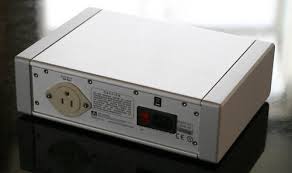
positivefeedback.com
Moving forward, I now placed one Qx4 field generation unit (placed in the critical location between wall socket and Q-Base) into my base system. First, many listeners, (including myself), perceived a natural increase in volume to the music, although no such adjustments had been made. I hypothesize that this effect had something to do with a lowering of the noise floor with the addition of one Qx4 unit. However, of more vital importance was the overall sense that a listener was now allowed greater access, (or what I would call a more intimate “camaraderie”) with the musicians performing on any given recording. This quality was again analogous to Bronzino’s visual work, where individual chalk lines come to resemble the textures of human flesh and the human qualities of the subjects come alive. A fine example of this analogous quality to Bronzino’s drawings in placing just one Qx4 unit into my audio system was heard on the recordings of the great chameleon himself, trumpeter Clark Terry.

Along with his stellar cast on “Talkin’ Trash,” (from the recording of the same name on DIW), Terry works up a vocal storm with his trademark mumbles, tumbles, twists and guffaws, alongside Christian McBride’s bass and Tony Reedus’ sparkling cymbal comments. With the insertion of the Qx4 unit, all of the human qualities of Terry’s every mumble and fumble were revealed with absolute clarity, texture and intonation. Remove the Qx4 and Terry was less a human presence, more robotic in character, with his slurs and purrs less clear, less revealed for all of their richness and inner life.

Another example could also be taken from Clark Terry’s compatriot (across the globe in Tanzania), Anania Nogoglia, himself a blind singer/thumb piano player. Nogoglia’s beautiful vocal twists and turns are captured with joyful flair in duet with Bela Fleck and his banjo on “Kabibi,” taken from Fleck’s recent Throw Down Your Heart, Africa Sessions [Rounder 11661]. Without the Qx4 in place, Nogoglia’s high vocals are more slurred, less vibrant and a bit flat; like a greyer, less vibrant version of the brilliant African colors he brings to life in this little number. As for Fleck’s delicate banjo accompaniment, it was almost indiscernible when the Qx4 and the Q-Base were removed from my system. Bringing back the Q-Base, Fleck’s banjo re-appears, with Fleck plucking sprightly next to Nogoglia. With the Q-Base, we get a much more coherent and organized sonic picture and clarity of soundstage elements. With the addition of one Qx4 unit, we gain better access to Nogoglia and Fleck’s human interplay and carefree sense of improvisation. We appreciate better their quick exchanges and retorts back and forth; their pauses to reply to the next musical gesture; all of this revealed while the musical conversation is moving at a very nimble pace.
Another beautiful example was revealed in the artistry of pianist Stephen Drury, captured live at New England Conservatory’s Jordan Hall performing the intensely complex work by Frederic Rzewski, The People United Will Never Be Defeated (Albion 063). At several points in this astonishing work, the pianist is called upon to strike a single chord like a bell, (letting it linger), or furiously pounce on a chromatic scale. With the one Qx4 in place, Rzewski’s drama was better revealed in both its inner compositional structure as well as for its tactile human qualities. When the Qx4 was removed (with the Q-Base still in place), the volume seemed to be turned down a notch, and one lost a sense of the directness and connection made with the Human playing the instrument; things were flatter, less involving and most importantly, less Human and more like Hi-Fi. As in Bronzino’s drawings, with the Qx unit, we can visualize the Human at work, the chalk lines that reveal both the underlying organization of the composition and more importantly, the revealing of the human qualities of the subject within.
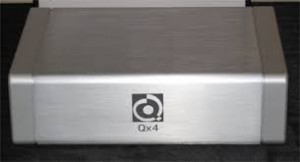
Adding additional Qx4 units into my base system continued this trend, but to a lesser degree. Qx4 units were placed on top of loudspeakers or adjacent to loudspeakers’ sides, (elevated on stands to be placed near the speaker’s bass drivers, as Quantum recommends). Also, Qx4 units were placed in front of, (or close to the sides of), amplifiers and front-end players. In all of these placements, improvements heard were increasingly subtle, as compared to the impact of the first Qx4 unit placed between wall and distribution block. These improvements were heard most consistently on larger-scale works, including Big Band and orchestral recordings. For example, take a listen to Paavo Jarvi conducting the smaller scale Deutsche Kammerphilharmonie Bremen in Beethoven’s Symphony No. 5 [RCA 88697]. The speed is furious, the flutes and piccolo soar and every bow of the deep basses are rendered pungent and full. With the addition of several Qx4 units as described above, one could now better discern the strings of the basses hitting their wooden bodies and also hear how those blaring trumpets in the final movement were played by sweating musicians, double tonguing and pitching in for more.
With the addition of more Qx4’s into the system, more drama is revealed, on both the organizational and, more importantly, the Human scale. However, I would conclude that since these Qx units are expensive (and their improvements more subtle as you add more of them into an already established reference system), one should start out with investing into proper AC mains support and cable consistency and then begin with a Q-Base (connected to a clean ground source, if possible) to gain all of its AC Distribution benefits feeding your established reference. Investing next in an initial Qx2 or Qx4 placed between wall and Q-Base would be highly recommended as the next step. Do keep in mind that “Quantumizing” your reference system is not going to change the essential sonic character of your established front end or loudspeaker system. What a Q-Base and Qx4 will offer, (like those exquisite Bronzano drawings), is a vital foundation, a scaffolding, that serves to not only make a reference system perform more coherently and intelligibly, but gets one closer to the illusion of hearing humans playing music on our favorite recordings. Once you have heard the benefits of these products at the foundation of your reference system – like the experience of viewing a Bronzano masterwork – your listening pleasure will be transported to another level of involvement and joy.
Associated System
Digital Front End
- EMM Labs CDSA
- CEC TL51XZ transport
- Audiomat Maestro II DAC
Amplification
- McIntosh MC 501 solid state monoblocks
- First Sound Presence Deluxe 4.0 MKII Preamp with Paramount Upgrade
- Accuphase 450 Integrated Amplifier
Loudspeakers
- Reference 3A Grand Veena
- Hansen Prince V.2
Cabling
- Nordost Tyr interconnects, speaker cable
- Nordost Valhalla digital cable
- Nordost Vishnu power cords
- TARA Labs ISM On Board 0.8 interconnects and speaker cables
Accessories
- Nordost Q-Base 4 and Q-Base 8; Nordost Qx2 and Qx4
- Argent Audio Dark Matter Base
- SSBC large pucks
- Nordost Quasar Isolation Points
- Echobuster Panels
- ASC bass traps and sound planks
- L’Art Du Son disc cleaner
Specifications
- Q-Base “QB4”:
- Four US Output Sockets; Input Socket: 15A IEC
- Fuse: none
- Dimensions (W/H/D/): 9.2”x 2.4”x 4.7”
- Weight: 3.5 lbs.
- Price: $799.99
- Q-Base “QB8”:
- Eight US Output Sockets; Input Socket: 15A IEC
- Fuse: none
- Dimensions: 18.1”x 2.25”x 4.75”
- Weight: 5.5lbs.
- Price: $1,299.99
- Qx2 Field Generation Unit:
- Two field generation modules
- Dimensions: 10.6”x 3.1”x 7.6”
- Weight: 10.5 lbs.
- Price: $1,699.99
- Qx4 Field Generation Unit:
- Four field generation modules
- Dimensions: 10.6”x 3.1”x 7.6”
- Weight: 11 lbs.
- Price: $2,499.99
If you would like to read more reviews like this one, visit Nelson’s blog at www.bostonconcertreviews.com.